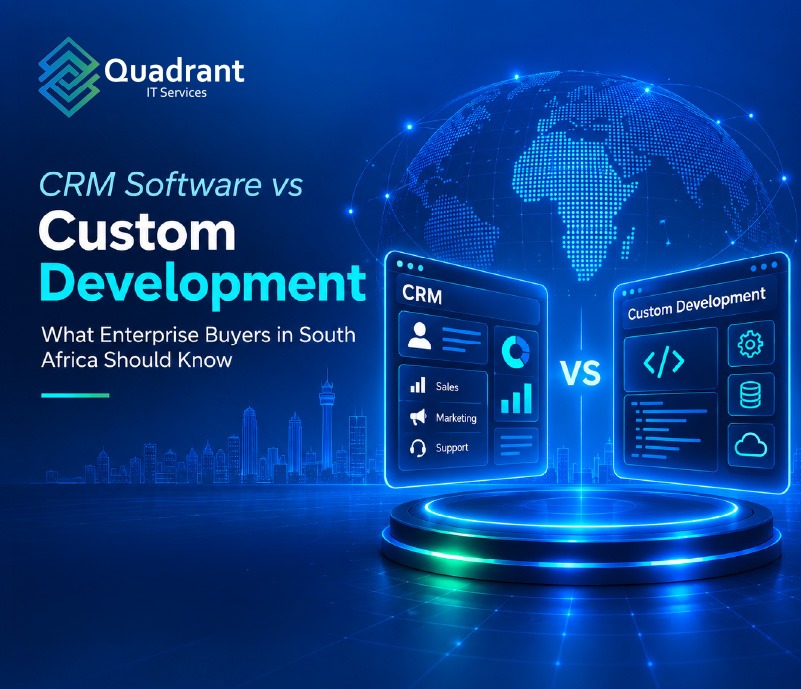




Choosing a CRM at enterprise scale is a different decision than it looks like on paper. It is not really a choice between two pieces of software. It is a choice about how thousands of customer records, years of transaction history, and multiple business units will work together for the next five to ten years.
The scale of this decision is not abstract. Gartner reports that more than 60% of B2B companies plan to switch or upgrade their CRM platform by 2026, and more than half of those migrations end up delayed or derailed by poor data quality, inadequate planning, or underestimated complexity. Get the decision right, and the CRM becomes a system your whole business runs on. Get it wrong, and you become part of that statistic.
At Quadrant Systems, ERP and CRM work has been part of what we do for over 13 years, for organisations that cannot afford downtime, data loss, or a system that does not hold up under real volume. That experience shapes how we think about this decision.
Platform or Custom Build: The Real Question
A ready made platform, something like Dynamics 365, comes with proven infrastructure, established security certifications, and a shorter path to going live. For a business with fairly standard processes across sales, service, and support, that is often the right foundation.
The tradeoff appears at scale. Licence costs are charged per user, so an organisation with hundreds or thousands of staff carries a recurring cost that grows every time the business grows. If your processes or reporting requirements do not match how the platform is built, you also carry the ongoing cost of customisation to close that gap, year after year.
A custom built CRM costs more to build initially, because it is designed around your business rather than adapted from a shared template. In exchange, there is no per seat licence compounding as you scale, and the system is built to match your actual processes and compliance requirements from day one.
Neither path is automatically correct. The right answer depends on the complexity of your operations, how tightly the CRM needs to integrate with your existing ERP, billing, or compliance systems, and how much your processes are likely to change as the business grows.
Why Migration Is Where Most CRM Projects Actually Fail
A recent industry benchmark, based on 87 implementation partners managing over 2,800 migrations, found that 54% of organisations experience significant migration delays, 67% discover major data quality issues partway through the process, and 43% report problems still surfacing more than six months after go live (2026 HubSpot Migration & Integration Benchmark Report, via SyncMatters).
Separate research puts overall CRM implementation failure between 30% and 63%, but with an important detail: most of that failure is not technical. One widely cited analysis found that while data migration itself succeeds in around 90% of cases, roughly 70% of CRM implementations still fail to meet their stated objectives, because staff quietly stop using the new system or revert to old habits within weeks of launch (RevOps analysis, Medium).
Put together, this tells an enterprise buyer something specific: the risk is rarely whether the data can technically be moved. It is whether the migration is planned properly, and whether the system is actually adopted once it is live.
What a Genuine Implementation Partner Should Bring
At this scale, a CRM partner needs to bring more than technical setup. That includes an honest assessment of your existing systems before recommending a platform or a custom build, a migration plan that accounts for data cleansing and validation rather than a straightforward export and import, integration work that connects the CRM properly with ERP, billing, and compliance systems already in place, and structured training and adoption support so the system gets used the way it was designed to be, not abandoned in favour of spreadsheets a few months later.
A partner who proposes a platform before understanding your existing architecture and compliance requirements is not equipped to support an enterprise rollout.
Where Quadrant Systems Fits
We work with organisations across banking, insurance, logistics, and other regulated industries on both platform implementation and custom CRM development, including reviewing existing ERP and CRM systems, migrating data from legacy platforms without disrupting daily operations, integrating CRM with the broader systems a business already runs, and training teams to ensure real adoption once the system goes live.
Our approach is to recommend the option that actually fits your business, not the option that is easiest to deliver. If your organisation is weighing this decision, the right first step is a proper assessment of your current systems and requirements, not a platform demo.
To talk through what your business actually needs, reach out to our team.
FAQs
- Should a large enterprise choose a ready made CRM platform or a custom build?
It depends on the complexity of your operations. A fairly standard sales and service process is often well served by a platform like Dynamics 365. An organisation with complex approval chains, compliance requirements, or deep integration needs with existing ERP and billing systems tends to get more long-term value from a custom build. - Why do so many CRM migrations fail or get delayed?
Industry research points to data quality issues as the leading cause. A recent benchmark of over 2,800 migrations found that 67% of organisations discovered major data quality problems partway through the process, and 54% experienced significant delays as a result. - Is CRM migration mostly a technical risk or an adoption risk?
Both, but adoption tends to be the bigger factor. Research shows data migration itself succeeds in around 90% of cases, yet roughly 70% of CRM implementations still fail to meet their objectives, largely because staff stop using the new system or revert to old processes after launch. - What should an enterprise look for in a CRM implementation partner?
A partner who assesses your existing systems honestly before recommending a platform or custom build, plans for data cleansing and validation rather than a simple export and import, handles integration with your ERP and compliance systems properly, and provides structured training to ensure real adoption, not just technical go-live.